

Scale your US business. Discover how advanced document intelligence software and ai document processing transform manual back-office workflows.

What does AI readiness actually mean for a 200-person company? Discover the 4 practical dimensions of preparing your business for AI without the buzzwords.

The phrase AI-ready gets used constantly, but rarely defined with any precision. Analysts say companies need to be AI-ready before they invest. Consultants offer AI readiness assessments without explaining what the readiness score actually measures. Technology vendors use the term to describe almost anything. For a 200-person company, large enough to have real operational complexity, small enough that a failed technology investment genuinely hurts, vague definitions are not useful. You need to know specifically what AI-ready means for a business at your scale, and what it takes to get there if you are not there yet.
This post gives you a practical answer to that question. Not a checklist of buzzwords, but a clear picture of what the four dimensions of AI readiness actually look like at a mid-size company, and what it means when one of them is missing.
Companies fail at AI for predictable reasons. They buy a tool before identifying the problem it should solve. They underestimate the data work required. They skip the process definition step and try to automate workflows that are not yet stable. They announce an AI initiative without building executive alignment around what success actually looks like.
According to research from MIT Sloan Management Review, the majority of companies that struggle with AI implementation cite internal factors, not technology limitations, as the primary cause. Technology is rarely the problem. In fact, usually, the organization is.
AI readiness, properly understood, is an organizational assessment, not a technology audit. The question is not whether your servers can run an AI model. It is whether your business is structured in a way that lets AI work.
A rigorous AI readiness assessment for a mid-size company covers four areas: data, process, people, and infrastructure. Each one can block an AI initiative independently. A company that has strong data but broken processes will build a system that learns from clean inputs and produces outputs that nobody acts on. A company with good processes and poor data will build a system that cannot be trained accurately. All four dimensions need to be evaluated and addressed.
This is one of the most common questions mid-size businesses ask, and the honest answer is that it depends on the use case. A customer churn prediction model needs years of customer behavior data. An invoice classification system can be trained on a few thousand labeled examples. A demand forecasting tool needs enough historical sales cycles to identify real patterns rather than noise.
What matters more than volume is quality and accessibility. Data that exists but lives in five disconnected systems, requires manual export to use, and has inconsistent field definitions across years is not ready for AI development. Data that is centralized, consistently structured, and retrievable through an API or data warehouse is. For most 200-person companies, the data work that needs to happen before AI development is less about generating new data and more about making existing data usable.
Poor data readiness usually looks like this: the business has been operating for years and has plenty of historical records, but those records are spread across a legacy ERP, a CRM that was implemented five years ago and never fully migrated from the previous one, several spreadsheets that individual team members maintain independently, and a customer database that was cleaned once in 2019 and not since.
That is not a data problem that AI can solve. It is a data problem that has to be solved before AI becomes viable. The most common mistake mid-size companies make is assuming that an AI system will organize and clean the data for them. It will not. Data preparation is pre-work, and for many businesses it is the most time-consuming part of the readiness phase.
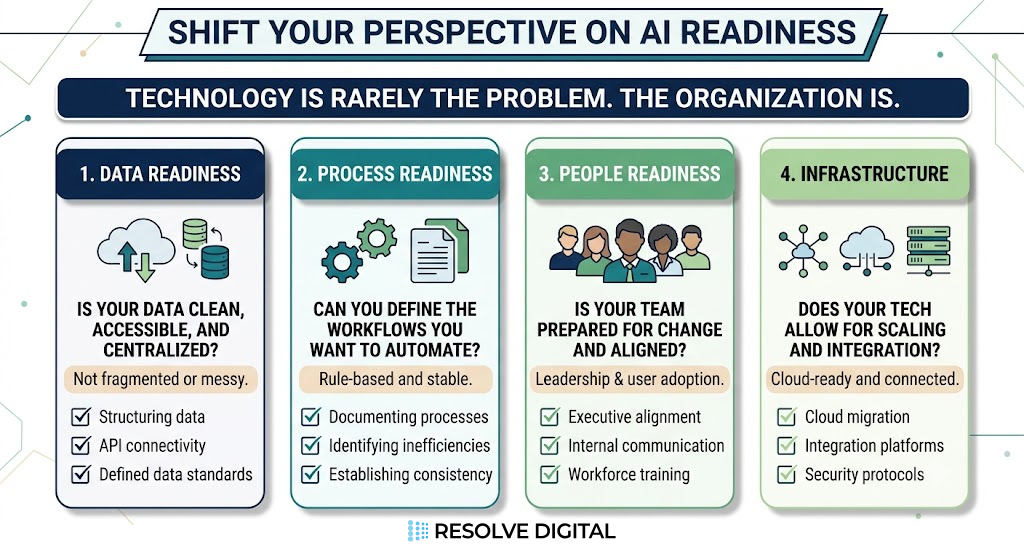
The best AI candidates at a 200-person company are processes that are high volume, rule-based, and currently consuming significant human time on tasks that do not require judgment. Accounts payable, employee onboarding document processing, customer inquiry routing, inventory management triggers, and compliance reporting are all common examples.
The worst AI candidates are processes that are inconsistent, poorly documented, or heavily dependent on contextual judgment that varies by situation. If you ask ten people in your company how a workflow runs and get ten different answers, that process is not ready for automation. Defining it clearly is the prerequisite.
At 2,000 employees, an enterprise AI strategy typically involves a dedicated data science team, a technology governance committee, and a multi-year roadmap with significant capital allocation. At 200 employees, the strategy needs to be more focused and more practical. You are not building an AI department. You are identifying two or three high-value use cases, finding an implementation partner, and deploying something that solves a real problem within a defined timeframe.
That focus is actually an advantage. Mid-size companies can move faster than large enterprises because they have fewer stakeholders, less bureaucracy, and more flexibility to change how teams work. Understanding the phases of custom software development helps set realistic expectations for what an AI implementation timeline actually looks like at this scale.
Most 200-person companies do not have data scientists on staff, and they do not need them to implement AI successfully. What they do need is an operations leader who understands what the AI system is supposed to do and can evaluate whether it is doing it, an IT contact who can manage the integration with existing systems, and frontline team members who are prepared to change how they work once the system is live.
The preparation gap that causes the most problems is not technical skill, it is change readiness. Harvard Business Review research on AI adoption consistently finds that teams who understand why AI is being introduced and how it will change their day-to-day responsibilities adopt new tools far more successfully than teams who are informed of changes after the fact. Communication is not a soft consideration. It is a readiness factor.
The infrastructure requirements for AI at a 200-person company are more modest than most business leaders assume. You do not need a custom data center or a specialized AI hardware environment. What you do need is cloud infrastructure that can scale with the system, clean API connectivity between your core business systems, and a data pipeline that moves information from your operational systems to wherever the AI model is running.
Companies still running primarily on-premise infrastructure should plan for cloud migration as part of the AI readiness work, not as a separate initiative that follows later. The two are connected, and sequencing them correctly saves significant time and cost. Understanding how long custom software development takes is an important context for planning the full readiness-to-deployment timeline realistically.
A company is genuinely ready for AI when it can answer yes to four questions. Do we have clean, accessible data relevant to the problem we want to solve? Do we have clearly defined processes that are stable enough to automate? Do we have executive alignment on what success looks like and who is accountable for it? And do we have the infrastructure to integrate a new AI system with our existing tools?
Most 200-person companies that do an honest self-assessment find that they are ready on two or three of those dimensions and need work on one or two. That is normal, and it is not a reason to wait. It is a reason to start the readiness work now so that when you are ready to build, you are not discovering blockers mid-project.
An AI readiness assessment is a structured evaluation of a company's data, processes, people, and infrastructure to determine how prepared the organization is to implement AI successfully. It matters because companies that skip this step frequently invest in AI development before the foundational requirements are in place, resulting in systems that underperform, fail to integrate, or are never adopted by the teams they were built for.
A thorough AI readiness assessment for a 200-person company typically takes two to four weeks, depending on the complexity of the organization's data infrastructure and the number of processes being evaluated. The output is a clear picture of where the company stands, what needs to change before development begins, and which use cases represent the highest-value starting points.
Digital transformation is a broad term that encompasses the shift from analog to digital processes across an organization. AI readiness is more specific, it refers to whether a company has the data, process stability, organizational alignment, and technical infrastructure to successfully implement AI. A company can be digitally transformed and still not be AI-ready if its data is fragmented or its processes are inconsistently defined.
A good AI consulting partner helps with both. Readiness assessment and scoping work is typically where the most value is created, because it determines whether the development phase is set up for success. Engaging a consulting partner before committing to a full development build is consistently more cost-effective than discovering readiness gaps after development has started.
Resolve Digital works with mid-size businesses navigating the question of AI readiness honestly. We help you assess where you actually stand, identify the highest-value use cases for your specific operation, and build a roadmap that reflects your real constraints rather than a generic AI strategy framework.
If you are preparing your business for AI and want an outside perspective on where to start, contact us for a free strategy call. We will tell you what we see and what we would do, without pushing you toward a build you are not ready for.
It also helps to understand how to succeed in custom software development projects before you move from readiness into development.
The right partnership can elevate your online presence and grow your business by attracting your dream customers. Whether you're building a luxury eCommerce store from scratch, improving your site or migrating platforms, Resolve Digital can help. Get in touch to learn more about our end-to-end eCommerce services.