
85% of organizations use AI agents today. Discover what they do, the ROI they deliver, and why waiting could cost your business.

Outgrown basic SaaS? Discover why US mid-market firms hit a wall with off-the-shelf AI tools and when it makes financial sense to build a custom solution.
Off-the-shelf AI tools have never been more capable or more accessible. You can sign up for an AI writing assistant, a customer support chatbot, a predictive analytics dashboard, or a document summarization tool in an afternoon. For straightforward use cases with predictable inputs and standard workflows, many of these tools work well. They are fast to deploy, familiar in format, and cheap enough to justify experimenting with.
But there is a category of business problem, common at mid-size companies operating at genuine complexity, where off-the-shelf AI tools consistently fall short. Not because the tools are poorly made, but because they were designed for the average use case, and complex business operations are not average.
This post explains where off-the-shelf AI limitations show up most clearly, what bespoke AI solutions actually provide that packaged tools cannot, and how to evaluate whether your situation calls for a custom AI development company rather than another SaaS subscription.
Off-the-shelf AI tools are built for broad market adoption. That means they are optimized for the most common version of a given use case, integrated with the most widely used platforms, and designed to be configured rather than modified. For a small business using standard software stacks with predictable workflows, this is exactly what is needed. The tool works out of the box, the setup is manageable without technical expertise, and the cost is proportionate to the value delivered.
The problem begins when the use case deviates from what the tool was designed for. When your data is structured differently than the tool expects. When your workflow has steps that the tool's logic does not accommodate. When your integration requirements go beyond what the vendor's API can handle. When the volume of your operation strains the tool's performance limits. At that point, the off-the-shelf tool stops being a solution and starts being a constraint.
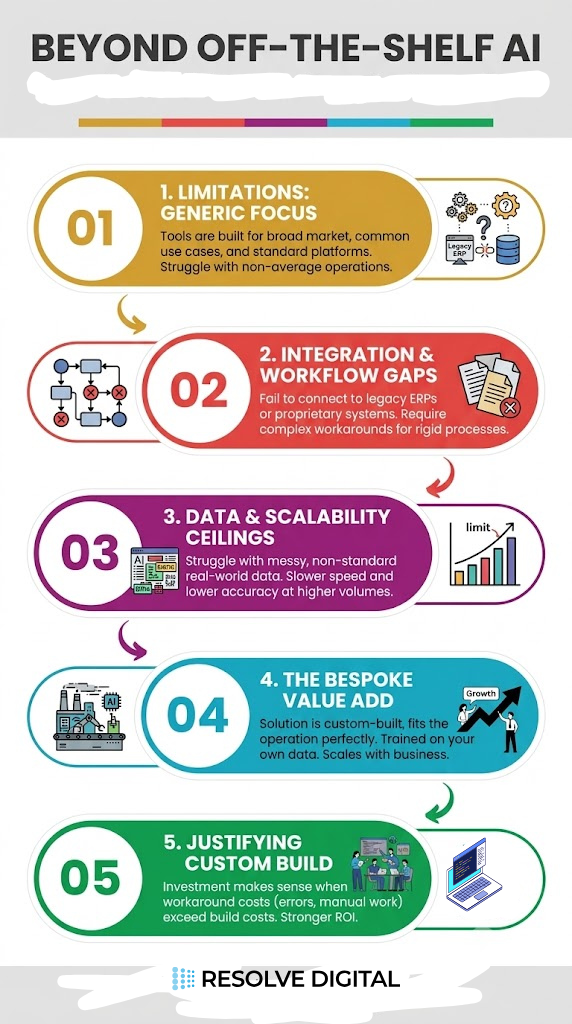
The limitations that mid-size businesses encounter most frequently fall into four categories. First, integration gaps: the tool connects to a standard set of platforms but not to the legacy ERP, proprietary database, or industry-specific system that is central to how the business actually runs. Second, workflow rigidity: the tool processes inputs in a fixed sequence that does not match the company's actual process, requiring the company to adapt its operations to the tool rather than the other way around.
Third, data format constraints: the tool was trained on or designed for a standard document or data format, and the company's real-world documents, with their variation, non-standard structures, and industry-specific terminology, fall outside what the model handles accurately. Fourth, scalability ceilings: the tool performs adequately at low volume but degrades in accuracy or speed as transaction volume increases, creating a ceiling on how much operational value it can actually deliver.
A bespoke AI solution is built around your specific operation. The model is trained on your data, not on a generic dataset that approximates what your data looks like. The workflow logic reflects your actual process, including the exception handling, escalation rules, and edge cases that your team deals with every day. The integration connects directly to the systems your business runs on, regardless of whether those systems are on a standard vendor's integration list.
The practical difference is that a bespoke AI solution fits. It does not require your operation to change its data structure to match the tool's expectations. It does not break when a document arrives in a format the vendor did not anticipate. It does not stop working when you scale past the tier limit. It was designed for your use case, not for a generalized version of it.
Custom AI development is justified when the cost of the limitation exceeds the cost of the build. That calculation is more often favorable than business leaders initially assume. Off-the-shelf AI tools that do not fully fit the use case generate hidden costs: manual workarounds, error correction, integration maintenance, and the opportunity cost of a process that is partially automated but not reliably so. Understanding what custom software development actually costs is the starting point for making that comparison accurately rather than on assumptions.
According to McKinsey's research on enterprise AI adoption, companies that deploy AI tailored to their specific workflows consistently report higher satisfaction with outcomes and stronger ROI than those using generic tools applied to complex use cases. The gap widens as operational complexity increases.
Off-the-shelf AI tools come with a fixed list of native integrations. If your business runs on Salesforce, HubSpot, QuickBooks, and a handful of other mainstream platforms, that list probably covers your needs. If your business runs on an industry-specific ERP that was implemented ten years ago, a proprietary order management system built in-house, and a data warehouse that was migrated from a legacy platform with non-standard schemas, the off-the-shelf tool's integration list is largely irrelevant.
This is not an edge case. It is the reality for a significant portion of mid-size businesses that have grown through acquisition, invested in custom technology over the years, or operate in industries where specialized systems are the norm. For these businesses, AI integration services are not a nice-to-have addition to a packaged tool. They are the core of the engagement, and they require custom development by definition.
Standard software integrations move data between systems in a predictable format. They are important but relatively straightforward to implement with off-the-shelf middleware. AI integration services are more complex because the AI system does not just receive and pass along data, it processes it, transforms it, makes decisions about it, and outputs results that downstream systems then need to act on.
That means the integration has to handle not just data transport but also the model's output format, the exception routing when confidence is low, the logging and audit trail requirements for compliance, and the feedback loop that allows the model to improve over time based on the outcomes it produces. Building that correctly requires a development team that understands both the AI architecture and the systems it needs to connect to, a combination that most off-the-shelf tool vendors are not positioned to provide for non-standard environments.
Off-the-shelf AI tools are priced and architected for a range of usage volumes. Within that range, they perform as advertised. Beyond it, performance degrades, pricing jumps to enterprise tiers that change the cost-benefit calculation significantly, or the tool simply does not support the volume the business needs to process.
Custom AI solutions are architected for the scale they need to operate at, with headroom for growth built in from the start. When your transaction volume doubles, the system scales to handle it. When you add a new document type or a new workflow, the model can be extended rather than replaced. When your business acquires a new division with different data formats, the system can be trained on those formats without starting from scratch.
Building for growth means making architecture decisions at the start of the project that accommodate future scale rather than optimizing only for the current state. It means choosing infrastructure that can scale horizontally, designing data pipelines that can handle increasing volume without degradation, and structuring models so that they can be retrained and extended as the business evolves. The essential guide to custom software development covers the foundational principles that apply equally to AI development: scoping clearly, choosing the right architecture, and building with maintainability in mind from day one.
The clearest sign is workarounds. If your team is maintaining spreadsheets to compensate for what the AI tool cannot do, manually reformatting data before it enters the system, or handling exceptions at a volume that negates the time savings the tool was supposed to create, you have outgrown the tool. The workarounds are the cost of the limitation made visible.
Other signs include integration failures that require manual intervention to resolve, accuracy rates that fall below what is acceptable for the process being automated, vendor roadmaps that do not align with your requirements, and a growing list of use cases that the tool simply cannot address regardless of configuration. Any one of these is a signal. Multiple of them together is a clear case for evaluating custom development.
The right custom AI development company understands both the AI architecture and the business problem it is solving. Technical capability is necessary but not sufficient. A development firm that can build sophisticated models but does not invest time in understanding how your operation actually runs will build something technically impressive that does not fit the way your business works. Choosing a development partner and knowing what you are paying for is one of the most important decisions in any custom AI engagement, and the criteria go beyond technical credentials to include communication, transparency about constraints, and a genuine understanding of your business context.
According to Gartner's research on enterprise AI implementation, the gap between AI projects that deliver business value and those that do not is most strongly correlated with the quality of the problem definition and the fit between the solution architecture and the specific business environment, not with the sophistication of the underlying models. Custom development done right starts with business understanding, not technology selection.
The main limitations are integration gaps with non-standard or legacy systems, workflow rigidity that requires the business to adapt to the tool rather than the other way around, data format constraints that cause accuracy problems when real-world documents deviate from what the model was trained on, and scalability ceilings that limit how much operational value the tool can deliver as transaction volume grows. For businesses with straightforward operations and standard technology stacks, these limitations may never surface. For businesses with complex operations, they typically do.
It makes business sense when the cost of the off-the-shelf tool's limitations, including workarounds, error correction, integration maintenance, and unrealized efficiency gains, exceeds the cost of building something custom. For high-volume processes at mid-size companies, this calculation is often more favorable to custom development than initial estimates suggest, because the hidden costs of a partially working tool are frequently underestimated.
Standard software integration moves data between systems in a fixed format. AI integration services are more complex because the AI system processes, transforms, and makes decisions about data rather than simply routing it. The integration has to handle model outputs, exception routing, audit logging, compliance requirements, and the feedback loops that allow the model to improve over time. This level of integration requires a development team with both AI expertise and deep knowledge of the specific systems being connected.
An off-the-shelf AI tool can be deployed in days or weeks. A custom AI solution typically takes three to six months for a focused first deployment, depending on the complexity of the use case and the integration requirements. The time difference is real, but so is the difference in fit. A tool that is deployed in two weeks but requires ongoing workarounds and delivers partial results is not faster in any meaningful sense, it simply shifts the time cost from implementation to ongoing manual compensation.
Resolve Digital is a custom AI development company that builds bespoke AI solutions for mid-size businesses whose operations have outgrown what off-the-shelf tools can handle. We work with companies that need AI integration services for non-standard environments, custom models trained on their specific data, and solutions architectured to scale with their business rather than constrain it.
If you are evaluating whether a custom build is the right move for your operation, we offer a free strategy call where we give you a straight assessment of your options, including whether an off-the-shelf tool with the right configuration might actually be sufficient, or whether the limitations you are hitting require something built specifically for you. Contact us to get started.
The right partnership can help you elevate your online presence and grow your business by attracting your dream customers. Whether you're looking to develop a luxury eCommerce store from scratch, improve your existing site, or migrate to a different platform, Resolve Digital can help you succeed. Get in touch to learn more about our end-to-end eCommerce services!