
Integration & Automation
Before writing a single line of code, we spend time understanding how your business actually works. We map your processes, audit your data and existing tools, identify the highest-impact AI opportunities, and define a clear, prioritized roadmap. This phase stands alone as a structured engagement. You leave with a strategy you own, and the option to build with us.
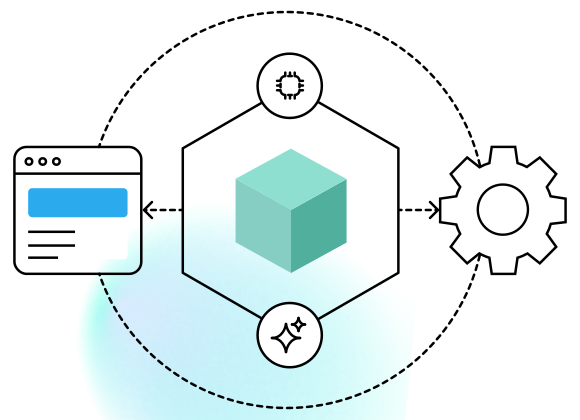
Most AI initiatives begin with a technology decision: a tool selected, a platform licensed, a proof of concept launched, before anyone has mapped the business processes that AI is supposed to improve. The result is AI that runs in isolation from the operations it was meant to transform, and a leadership team left to explain why the investment hasn't delivered.
We start differently. Our AI Strategy & Consulting engagement is designed to give your leadership team a precise, operations-based view of where AI creates real value in your specific context, before any engineering begins. The output is a prioritized roadmap grounded in your actual data, your actual workflows, and your organization's real capacity to execute.
How We Approach AI Strategy & Consulting

Our strategy engagements are led by the same senior team that would build the solution. That means every recommendation we make is grounded in what we know we can engineer, and every gap we identify is one we know how to close. You receive strategic advice with engineering accountability behind it, not a consulting deliverable that ends at the presentation.
That engineering discipline comes from 24 years of building systems that run in complex, real-world environments. We apply the same standards to every automation engagement: clear ownership, documented decisions, and accountability for performance that extends beyond go-live.
That eliminates the manual reconciliation between your sales and operations systems, with intelligent handling of records that require judgment to resolve.
processing incoming requests, documents, or cases, classifying them according to your business logic, and routing them to the appropriate team or system without manual triage.
pulling data from across your operational systems, transforming it into the format your reporting requires, and delivering it on a schedule, assembled automatically, every time.
Our strategy engagements are led by the same senior team that would build the solution. That means every recommendation we make is grounded in what we know we can engineer, and every gap we identify is one we know how to close. You receive strategic advice with engineering accountability behind it, not a consulting deliverable that ends at the presentation.
That engineering discipline comes from 24 years of building systems that run in complex, real-world environments. We apply the same standards to every automation engagement: clear ownership, documented decisions, and accountability for performance that extends beyond go-live.
We select the right technology for each engagement based on your existing infrastructure, your operational requirements, and the specific problem we are solving. Our team brings deep experience across the modern stack, and we work with what fits your environment rather than asking your business to adapt to ours.







Explore our FAQs and don’t hesitate to get in touch, we're happy to have a conversation about your situation and what working with us would look like.
General-purpose automation platforms serve straightforward, rule-based workflows between common SaaS applications well. We build custom automation for workflows that involve complexity, variability, or the need for genuine reasoning, and we design it to work alongside your existing automation infrastructure where that makes sense.
Yes. Integration with older systems, including proprietary databases, legacy platforms, and systems with limited or undocumented interfaces, is an area where we have deep experience. The technical approach depends on what the system supports, and we assess that clearly before committing to scope.
Exception handling is a first-class engineering concern in every automation we build. We design explicit handling for every identified exception path, including how the system surfaces the exception, who receives it, and what information they need to resolve it. Automation that handles the common case reliably, and manages the exception case gracefully, is what earns operational trust.
External system changes: API updates, platform migrations, data structure changes, are a normal part of operating integrated infrastructure. We provide ongoing maintenance for the integrations we build, and we design integration layers that localize the impact of external changes so that updates in one system don't cascade across the entire workflow.
A focused integration between two systems with well-defined data structures can move to production in four to eight weeks. Complex, multi-system workflow orchestration with AI decision-making takes longer, and we scope the timeline with transparency about what drives it. We deliver working automation incrementally so your team sees results before the full scope is complete.
Tell us about your business, your processes, your priorities, and where you are feeling the most friction. We will give you an honest view of where AI creates real value in your specific context, and what a disciplined first step looks like.


