

Over 80% of AI projects fail to reach production. Discover the 4 critical mistakes businesses make and how to successfully deploy AI that drives real ROI.

Stop wasting staff hours on manual data entry. Learn how US mid-market firms use Document Intelligence to extract and understand data with 95%+ accuracy.

Most businesses run on documents. Contracts, invoices, purchase orders, onboarding forms, compliance filings, customer applications, insurance claims, the list is long, the volume is high, and for most of the companies receiving them, the process is still largely manual. Someone opens the document, reads it, extracts the relevant information, enters it into a system, and routes it to the next step. Thousands of times per month.
Document intelligence software is changing that. Not by digitizing paper, that problem was largely solved a decade ago. By teaching software to understand what a document means, not just what it says. That distinction is what makes document intelligence genuinely transformative for the businesses that implement it correctly.
This post explains what document intelligence is, how it works, where it is creating the most significant operational change, and what mid-size businesses need to know before they evaluate it for their own operations.
Document intelligence is the application of artificial intelligence, specifically machine learning, natural language processing, and computer vision, to automatically classify, extract, interpret, and act on information contained in business documents. It is a significant step beyond optical character recognition, which converts printed text to digital characters without understanding what those characters mean.
An OCR system reads a vendor invoice and produces a block of text. A document intelligence system reads the same invoice, identifies it as an invoice rather than a purchase order or a delivery note, extracts the vendor name, invoice number, line items, amounts, and payment terms into structured data fields, cross-references the total against a corresponding purchase order, and flags a discrepancy if the amounts do not match within a defined tolerance. The difference between reading and understanding is what separates document intelligence from earlier generations of document automation.
AI document processing handles both structured and unstructured documents. Structured documents, tax forms, standard contracts, application forms, have predictable layouts that make extraction relatively straightforward once the model is trained. Unstructured documents, emails, free-text correspondence, varied invoice formats from different vendors, require the model to understand meaning and context rather than just locating data in a fixed position on the page.
Common document types that mid-size businesses process with document intelligence software include vendor invoices, purchase orders, contracts and agreements, employee onboarding documents, insurance claims, loan applications, compliance filings, medical records, shipping and customs documentation, and customer correspondence. The technology is not limited to any single industry or document category, which is why adoption is accelerating across sectors simultaneously.
The replacement happens task by task rather than role by role. Document intelligence software takes over the specific tasks within a document workflow that require reading, extracting, and routing, the parts that consume the most time and add the least judgment value. The people who were doing those tasks shift to handling exceptions, managing the system, and doing the work that requires contextual judgment the AI cannot replicate.
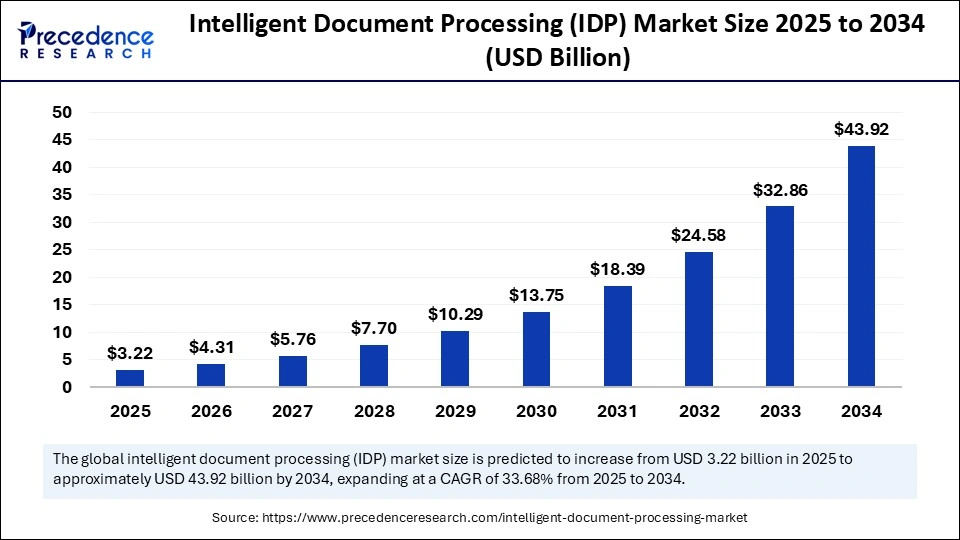
The scale of the shift is significant. IDC's research on the intelligent document processing market projects strong compound annual growth as mid-size businesses join large enterprises in adopting IDP at scale. The driver is consistent across company sizes: the labor cost of manual document processing is high, the error rate is measurable, and the ROI from automation is clear.
Contract automation AI is a specific application of document intelligence focused on contracts and legal agreements. At the intake stage, it classifies incoming contracts by type and extracts key terms, parties, effective dates, payment terms, renewal clauses, termination conditions, liability caps, and governing law provisions, into a structured format that can be stored, searched, and reported on.
At the review stage, contract automation AI compares extracted terms against a company's standard positions and flags deviations for attorney or business owner review. A non-disclosure agreement that contains a non-standard carve-out, a vendor contract with an auto-renewal clause buried in section 14, or a service agreement with a limitation of liability that falls below the company's minimum threshold, these are the kinds of issues that contract automation catches consistently, without the fatigue that affects human reviewers processing large volumes of similar documents.
The best starting point is the document type that your business receives at the highest volume and that currently requires the most manual handling. For most mid-size businesses, that is vendor invoices or customer application forms. These document types are well-understood by the technology, the ROI is measurable, and the integration requirements, connecting to an accounts payable system or a CRM, are manageable.
Starting narrow and expanding is consistently more successful than attempting to implement document intelligence across multiple document types simultaneously. A focused first deployment generates the ROI data and organizational confidence needed to justify expanding to adjacent use cases. It also surfaces the integration and exception-handling realities of your specific environment before they affect a broader rollout.
Integration is where most document intelligence implementations encounter their most significant technical challenges. The AI system needs to receive incoming documents, which typically means connecting to email, a document management platform, a scanning workflow, or an API from an upstream system. It needs to output extracted data to the systems that consume it, the ERP, the CRM, the contract management tool, the compliance platform. And it needs a human review queue for exceptions that the model flags as low confidence. Knowing how to succeed in a custom software development project is directly applicable here, because document intelligence is a software project with all the planning, scoping, and change management requirements that entails.
Earlier document automation tools required rigid templates. A vendor invoice from a new supplier formatted differently than the tool expected would fail to extract correctly. A contract with a non-standard structure would require manual setup before the tool could process it. AI document processing learns from variation. The evolution of machine learning applications in business operations illustrates how models trained on real-world data consistently outperform rule-based systems when documents deviate from expected formats, which, in practice, they frequently do.
The practical implication is that document intelligence software handles the real world better than earlier generations of automation. It does not break when a vendor changes their invoice template. It does not require manual reconfiguration when a new document type enters the workflow. It flags unfamiliar documents for human review and can be retrained on those documents to expand its capability over time.
Well-trained document intelligence systems achieve accuracy rates above 95 percent for standard document types within their training set on high-confidence extractions. Gartner's analysis of intelligent document processing adoption notes that production accuracy varies by document complexity and training data quality, with the most consistent results coming from implementations where the training data closely reflects the actual document variation the business receives. The critical design requirement is that low-confidence results are routed to human review rather than processed automatically, a properly designed system improves its accuracy over time as the human review decisions become additional training data.
Document intelligence software uses AI to automatically classify, extract, validate, and route information from business documents. It replaces the manual steps of reading a document, identifying the relevant data fields, extracting those values, and entering them into a business system. The software handles these steps automatically, flags exceptions for human review, and outputs structured data to the downstream systems that need it, without requiring a human to touch every document.
Financial services, healthcare, legal, real estate, logistics, and insurance are currently the heaviest users of document intelligence software, driven by high document volumes and significant compliance requirements. Manufacturing and professional services firms are adopting rapidly, particularly for accounts payable automation and contract management. The technology is industry-agnostic, any business that processes high volumes of incoming documents with consistent rules is a strong candidate.
A focused implementation covering a single document type typically takes six to ten weeks, including model training, integration development, and a parallel-run validation period. Multi-document-type implementations covering several workflow categories typically take three to six months. The single most important factor in implementation speed is data readiness: having a sufficient volume of labeled training documents available at the start of the project, and having the downstream systems accessible via API for integration.
Well-designed document intelligence systems are built to surface errors rather than hide them. When the model's confidence in an extraction falls below a defined threshold, the document is routed to a human review queue rather than processed automatically. This design means that the errors the system makes are visible and correctable, rather than silently entering downstream systems. Over time, the human review decisions on low-confidence documents can be used to retrain the model, reducing the error rate and the volume of exceptions requiring human review.
Resolve Digital builds custom document intelligence and AI document processing systems for mid-size businesses that have outgrown manual document workflows. We design systems around your specific document types, your existing infrastructure, and your integration requirements, not a generic template that requires your operation to adapt to the tool rather than the other way around.
If you are evaluating document intelligence software for your business and want to understand what implementation actually involves for a company at your scale, contact us for a free strategy call. We will give you a straight assessment of what is possible, what it requires, and what it is likely to cost, before you commit to anything.
It is also worth understanding what agentic AI means for mid-size businesses as document intelligence increasingly connects to broader AI workflows that go beyond single-document processing.
The right partnership can help you elevate your online presence and grow your business by attracting your dream customers. Whether you're looking to develop a luxury eCommerce store from scratch, improve your existing site, or migrate to a different platform, Resolve Digital can help you succeed. Get in touch to learn more about our end-to-end eCommerce services!