What is the real cost of waiting on AI? Discover how mid-market companies lose hundreds of thousands annually in labor overhead and operational efficiency.

Your team is spending hours on tasks AI could handle automatically! Here is what agentic AI actually is and how businesses like yours are using it right now.

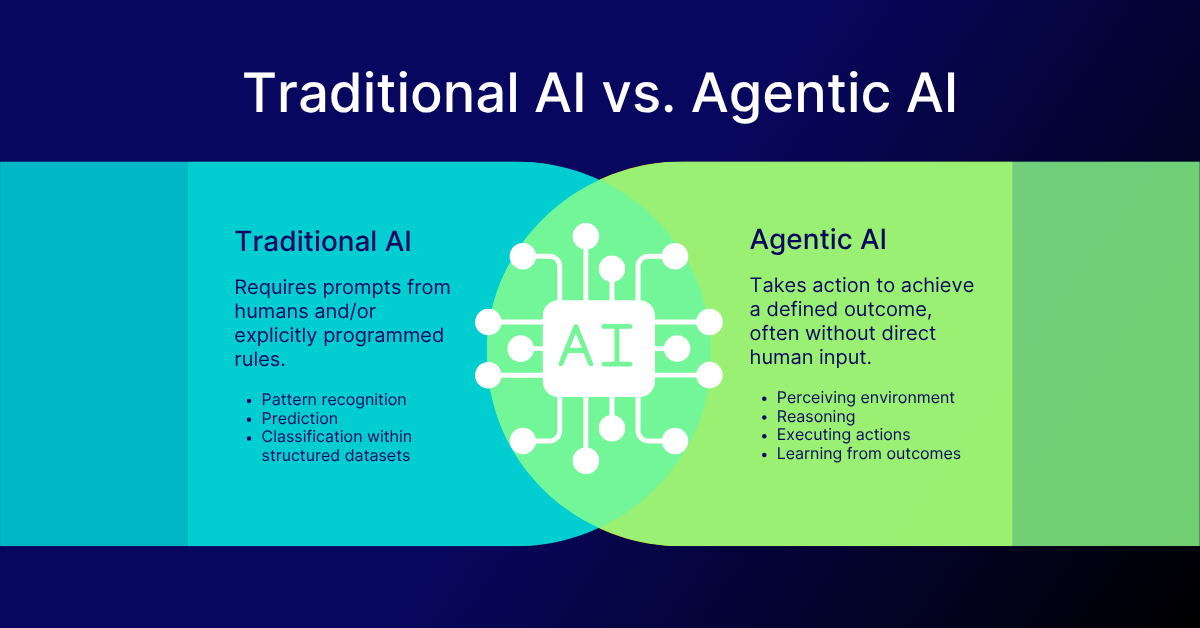
Most AI tools you have used so far are reactive. You type something in, they respond. That is useful, but it still requires a human to drive every step of the process.
Agentic AI is different because it is goal-oriented. You give it an objective, and it figures out the steps needed to reach that objective, uses the tools available to it, makes decisions along the way, and completes the task with minimal human input.
Think of the difference between a calculator and a financial analyst. The calculator gives you an answer when you punch in numbers. The analyst takes your business situation, breaks it down, pulls relevant data, identifies the problem, and comes back with a recommendation. Agentic AI operates much more like the analyst.
An AI agent is a software system built on a large language model that can reason through multi-step tasks, connect to external tools and data sources, and take actions in the real world. That might mean browsing the web, querying a database, sending an email, updating a record in your CRM, or triggering a workflow in another system.
A single agent handles one job. But most real business problems require more than one job. That is where multi-agent systems come in. Multiple agents work together, each handling a different part of a larger process, handing off work to each other the way a well-run team does.
According to Gartner, agentic AI is the number one strategic technology priority for businesses in 2025. And it is not hard to see why. The global AI agents market was valued at $5.4 billion in 2024 and is projected to reach $7.6 billion by 2025, with adoption accelerating fastest in the mid-market segment.
There is a meaningful difference between an AI tool and an AI system. Tools help individual people do individual tasks faster. Systems change how an entire operation runs.
Most businesses have experimented with AI tools by now. Someone on the marketing team uses it to write copy. Someone in ops uses it to summarize reports. These are useful, but they are isolated. They do not talk to each other. They do not remove work from the process. They just make individual steps slightly quicker.
Agentic AI operates at the system level. It connects to your existing software, understands your processes, and handles entire workflows from start to finish. The work does not just get faster. In many cases, it stops needing a human to manage it at all.
This is also why businesses that invest in custom software development tend to get far more out of AI than those relying on generic off-the-shelf tools. A custom-built foundation gives AI agents something solid to work with.
Say you run a mid-size lending company. Every day, your team manually reviews incoming loan applications, pulls credit data, checks documents, flags missing information, and routes files to the right people.
An agentic AI system can handle all of that. It reads the incoming application, pulls the relevant data from your systems, checks documents for completeness, flags anything missing with a message to the applicant, scores the application based on your criteria, and routes it to the appropriate team member for final review. The human only steps in at the decision point. Everything before that is handled.
That is not a futuristic scenario. Companies are running systems like this right now.
Large enterprises have the budget to hire hundreds of people to manage complex workflows manually. Small businesses often have simple enough operations that basic tools are enough. Mid-size businesses are in a different situation. Operations are complex. Teams are lean. The gap between what needs to happen and what the current team can handle is growing.
That is exactly the gap agentic AI fills.
A McKinsey report from late 2024 found that 23 percent of organizations are already scaling agentic AI systems in at least one business function, with an additional 39 percent actively experimenting. The businesses getting the most out of it are not the giant enterprises. They are the ones in the $20M to $150M range where every operational improvement has a direct and measurable impact on the bottom line.
One of the biggest misconceptions about AI transformation is that it requires ripping out your existing systems and starting over. It does not. Agentic AI is designed to work with what you already have. It connects into your CRM, your ERP, your project management tools, your document storage, and your communication platforms.
The value is not in replacing the tools you already use. It is in connecting them intelligently so they work as a system instead of a collection of separate applications that require people to move information between them manually.
If your current software infrastructure has not been properly maintained or updated, it is worth addressing that before layering AI on top of it. As we have covered in our guide to custom software maintenance, a clean and well-maintained stack is the foundation everything else builds on.
Repetitive, multi-step operational processes are the clearest win. Invoice processing, approval workflows, employee onboarding sequences, compliance checks, inventory alerts. These are tasks that follow rules, require coordination across systems, and currently consume significant staff time. Agents handle them accurately, consistently, and without getting tired.
AI agents can handle tier-one customer interactions, route inquiries, pull account information, answer common questions from your internal knowledge base, and escalate to a human only when the situation genuinely requires judgment. Response times go from hours to seconds, and your team focuses on the conversations that actually need them.
If your business handles a high volume of contracts, reports, applications, or forms, document intelligence built on agentic AI can read, extract, classify, and act on those documents automatically. Law firms, financial services companies, healthcare organizations, and construction firms are already seeing significant time savings here. According to a 2024 industry report, AI-powered document processing can reduce manual data entry by up to 80 percent in document-heavy environments.
Agentic AI can monitor your operational data continuously, surface anomalies before they become problems, and generate reports that your leadership team actually needs. Instead of waiting for a quarterly review to find out something went wrong six weeks ago, you find out the same week it started going sideways. We explored how AI and big data are reshaping business operations in an earlier post, and the same principles apply directly here.
AI is only as good as the data behind it. This is the most common blocker for businesses that are ready to move forward with agentic AI. Their data is scattered across systems, inconsistent in format, or simply not structured in a way that an AI can work with.
The good news is this is a solvable problem. A proper data structuring engagement before any AI build begins ensures the foundation is solid. Skipping this step is the most common reason AI projects fail to deliver the results businesses expect.
According to a 2024 Qlik study, lack of data readiness remains the primary barrier preventing enterprise AI from scaling. The fix always starts with getting the data infrastructure right before anything else.
There are off-the-shelf AI tools that promise to solve your workflow problems out of the box. For some very standard use cases, they work well enough. But mid-size businesses with specific processes, proprietary data, and unique operational constraints usually find that off-the-shelf tools solve 60 percent of the problem and leave the other 40 percent untouched.
Custom AI development means the system is built around your actual processes, your actual data, and your actual constraints. It takes longer to build than plugging in a SaaS tool, but it delivers results that a generic product simply cannot.
The McKinsey Global Survey on the state of AI confirms this. Organizations that redesign workflows around AI rather than bolting tools onto existing processes are consistently the ones seeing measurable enterprise-level impact.
The businesses that get stuck are usually the ones waiting until they have a comprehensive AI strategy before they do anything. The businesses that get results start with one high-impact, well-defined use case, prove it out, and build from there.
Identify the one process in your operation that costs the most time, involves the most handoffs, or creates the most errors when it goes wrong. That is your starting point.
Right now, mid-size businesses that move on agentic AI have a meaningful competitive advantage over the ones that are still watching from the sidelines. That window will not stay open indefinitely. As adoption accelerates across every industry, the gap between businesses running on intelligent systems and those still running on spreadsheets and manual handoffs will become harder and harder to close.
The question is not whether agentic AI will change how mid-size businesses operate. It already is. The question is whether your business is building that capability now or catching up later.
At Resolve Digital, we design, build, and integrate custom AI systems for mid-size businesses that have complex operations and are ready to move. We have been delivering custom software solutions since 2002, and we bring that same hands-on, long-term approach to every AI engagement.
We start with a structured discovery process to find where AI creates the most leverage in your operation. Then we build it. Then we stay with you as a long-term partner to maintain, improve, and expand it over time.
If you want to understand what agentic AI could look like in your specific business, we offer a free strategy call with no commitment. It is a real conversation with people who have built these systems, not a sales pitch.
Contact us to book your free strategy call today.
The right partnership can help you elevate your online presence and grow your business by attracting your dream customers. Whether you're looking to develop a luxury eCommerce store from scratch, improve your existing site, or migrate to a different platform, Resolve Digital can help you succeed. Get in touch to learn more about our end-to-end eCommerce services!