
85% of organizations use AI agents today. Discover what they do, the ROI they deliver, and why waiting could cost your business.

Don't waste budget on generic slides or broken code. See how pairing AI consulting with development sets ANZ businesses up for measurable ROI.

Two businesses in the same industry. Both decide they need to do something with AI. One hires an AI consulting firm. The other hires an AI software development company. A year later, one of them had a working system that changed how their operation runs. The other has a polished strategy document and a lot of unanswered questions about what to actually build. The confusion between AI consulting and AI development is one of the most expensive mistakes mid-size businesses make when approaching artificial intelligence. They are not the same thing. They do not produce the same outputs. And hiring the wrong one at the wrong time sets a project back by months.
This post explains what each actually involves, when you need one versus the other, and how to tell whether a firm you are evaluating is genuinely capable of both or just using the terms interchangeably to win business.
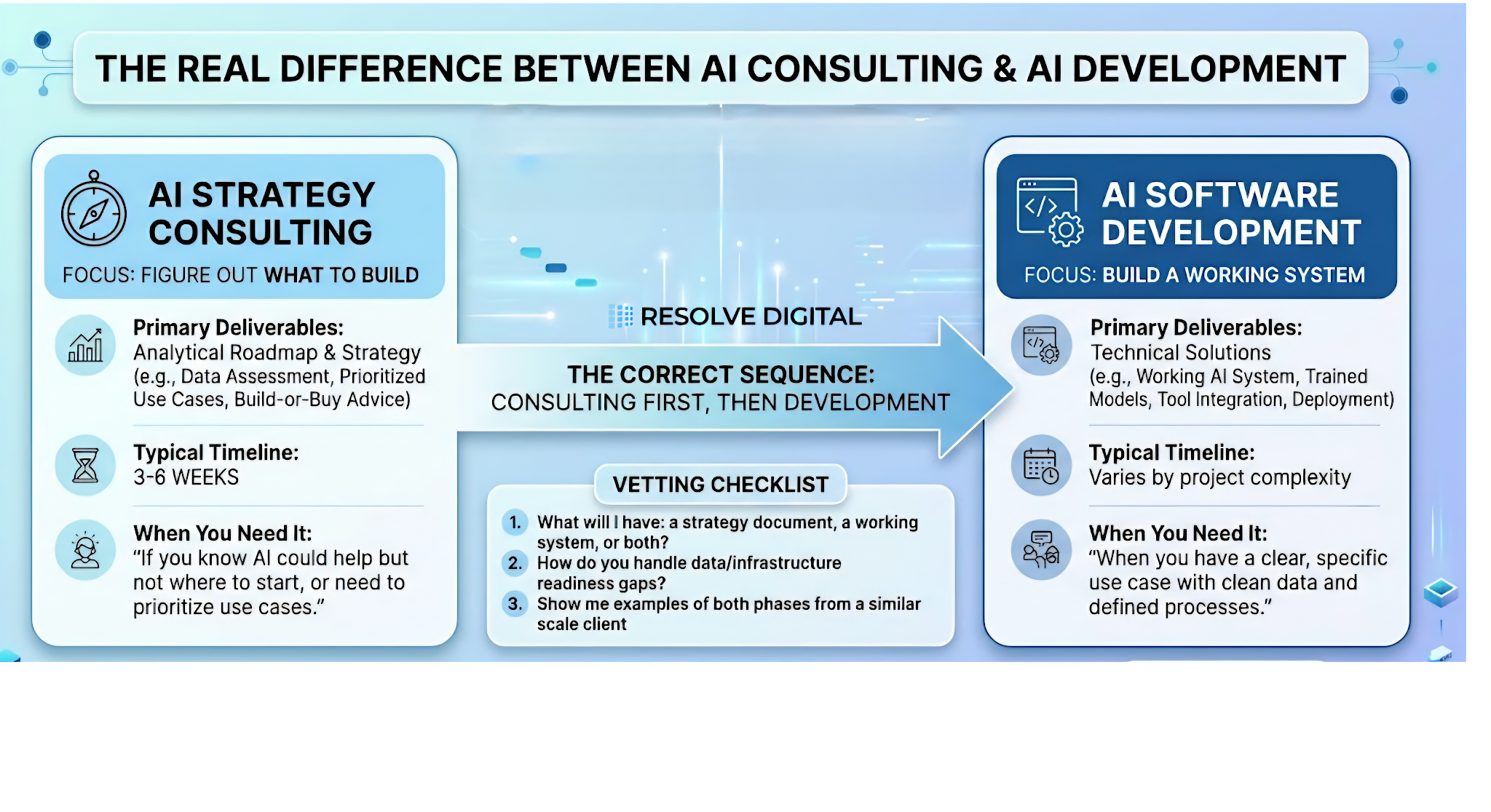
An AI consulting firm helps a business figure out what to build before anything gets built. The deliverables are analytical: a current-state assessment of your data, processes, and technology infrastructure; an identification of the use cases where AI could create measurable value; a prioritized roadmap that sequences those use cases by feasibility and impact; and a build-or-buy recommendation for each.
Good AI strategy consulting is specific to your business. It is not a generic AI adoption framework with your company name inserted at the top. It accounts for your actual data situation, your existing systems, your team's capacity to absorb change, and the competitive dynamics of your market. The output should be a roadmap that a capable development team can execute, not a set of aspirational slides that leaves execution entirely open.
A business needs AI consulting rather than development when it does not yet have a clear, specific use case to build. If you know that AI could help your business but you are not sure where to start, consulting is the right first step. If you have multiple potential use cases and are not sure which to prioritize, consulting surfaces the answer. If you have been told by someone that you need AI but you are not sure what problem it would solve, consulting is where that question gets answered properly.
Skipping the consulting phase and going straight to development when the use case is unclear is one of the primary reasons AI projects fail. McKinsey's research on AI adoption consistently identifies lack of clear business problem definition as a top factor in failed implementations. The development work is not where strategy gets figured out. It is where a clear strategy gets executed.
An AI software development company takes a defined use case and builds it. The deliverables are technical: a working AI system, trained models, integration with your existing tools, a testing and validation process, and deployment infrastructure. Where a consulting firm produces a roadmap, a development firm produces software.
Custom AI solutions are built around your specific data, your specific workflow, and your specific integration requirements. They are not off-the-shelf tools configured to your account. They are systems designed from the ground up to solve the problem you have identified, trained on your data, and integrated into the way your operation actually runs.
Off-the-shelf AI tools are built for the average use case in a given category. They work well when your requirements match what the tool was designed for. They break down when your data is structured differently than the tool expects, when your workflow has steps the tool does not support, or when your integration requirements go beyond what the vendor's API can accommodate.
Custom AI solutions are built for your use case specifically. The model is trained on your data. The workflow logic reflects your process. The integration connects to your systems, not a generic set of enterprise platforms. Understanding what the custom software development process involves makes clear why the effort is justified when the requirements do not fit what an off-the-shelf tool can provide.
Yes, and in many cases working with a firm that does both produces better outcomes than working with two separate firms in sequence. When the team that builds the strategy is also building the system, there is no translation layer between what was planned and what gets built. The consulting phase informs the development architecture directly, and the development team can push back on strategic assumptions that would be technically difficult or expensive to implement.
The risk with a firm that does both is that the incentive structure can pull toward development. A firm that earns more from building than from advising has a financial reason to recommend building something even when the readiness work is not done. Understanding this dynamic helps you evaluate whether a firm's recommendations reflect your actual situation or their preferred engagement model.
Before hiring any firm, ask three questions. First, what will I have at the end of this engagement, a strategy document, a working system, or both? Second, how have you handled situations where the data or infrastructure was not ready for what the client wanted to build? Third, can you show me examples of projects at a similar scale to mine, and can I speak with those clients directly?
The answers tell you more about a firm's actual capabilities than any credentials document. A development firm that cannot articulate how it handles readiness gaps is likely to discover them mid-project. A consulting firm that cannot name specific technical constraints it has identified for clients is probably producing generic output. Knowing how to choose the right custom software development company is the foundation for making a good decision at this stage.
Consulting first, development second. This sequence is almost always correct, and the exceptions are narrow. If you already have a clearly defined use case, clean data, stable processes, and a technical architecture that supports integration, you can move directly to development. Most mid-size businesses do not have all four of those things in place simultaneously, which means some consulting-phase work is required even if the engagement is framed primarily as a development project.
The phases of a well-run AI engagement follow a logical progression: discovery and assessment, use case definition, architecture design, model development, integration, testing, and deployment. Understanding what those phases look like in practice helps business leaders set realistic expectations for timeline, cost, and what they will need to provide at each stage.
A focused AI strategy consulting engagement for a mid-size business typically takes three to six weeks. That covers a current-state assessment, use case identification and prioritization, a readiness evaluation across data and infrastructure, and a roadmap with enough technical specificity to begin architecture design. Longer engagements covering more complex organizations or multiple business units can run eight to twelve weeks.
According to Gartner's research on AI project timelines, organizations that invest in structured pre-development planning consistently deliver AI projects faster and with fewer mid-project scope changes than those that begin development before the strategy is clear. The consulting phase does not slow the project down. It removes the rework that slows it down later.
AI consulting is the strategic phase: assessing your business, identifying where AI can create value, and producing a roadmap for implementation. AI development is the execution phase: building the actual system, training the models, integrating with your existing tools, and deploying a working solution. Consulting tells you what to build and why. Development builds it.
If you have a specific, well-defined use case with clean data and stable processes, you may be able to move directly to development. In practice, most businesses that believe they know exactly what they want to build discover during early development that the requirements are less defined than they thought, or that the data situation requires work that was not anticipated. A brief scoping engagement at the start of a development project typically surfaces and resolves these issues before they become costly.
Ask for case studies that show both phases of an engagement, the strategic output and the technical deliverable that followed from it. Ask how many of their consulting engagements resulted in development work, and how many resulted in a recommendation not to build. A firm that always recommends building is not giving you independent strategic advice. Ask to speak with clients who went through both phases with the same team.
The most common outcome is mid-project scope change. The development team starts building against requirements that were not fully validated, discovers that the data is not structured as expected, or finds that the integration with existing systems is more complex than anticipated. The project slows, the budget increases, and the timeline extends. The cost of a few weeks of consulting at the start is consistently lower than the cost of rework mid-development.
Resolve Digital works with mid-size businesses across both phases of AI engagement. We assess your business, identify the right use cases, and build the systems that follow from that strategy, without the gap that forms when two separate firms hand off between phases. Whether you need AI strategy consulting to figure out where to start, or you are ready to hire an AI software development company and move into build mode, we bring the technical and strategic depth to do both without wasted cycles.
We offer a free strategy call for businesses that want an honest read on where they are and what the right next step looks like. Contact us to get started!
The right partnership can help you elevate your online presence and grow your business by attracting your dream customers. Whether you're looking to develop a luxury eCommerce store from scratch, improve your existing site, or migrate to a different platform, Resolve Digital can help you succeed. Get in touch to learn more about our end-to-end eCommerce services!